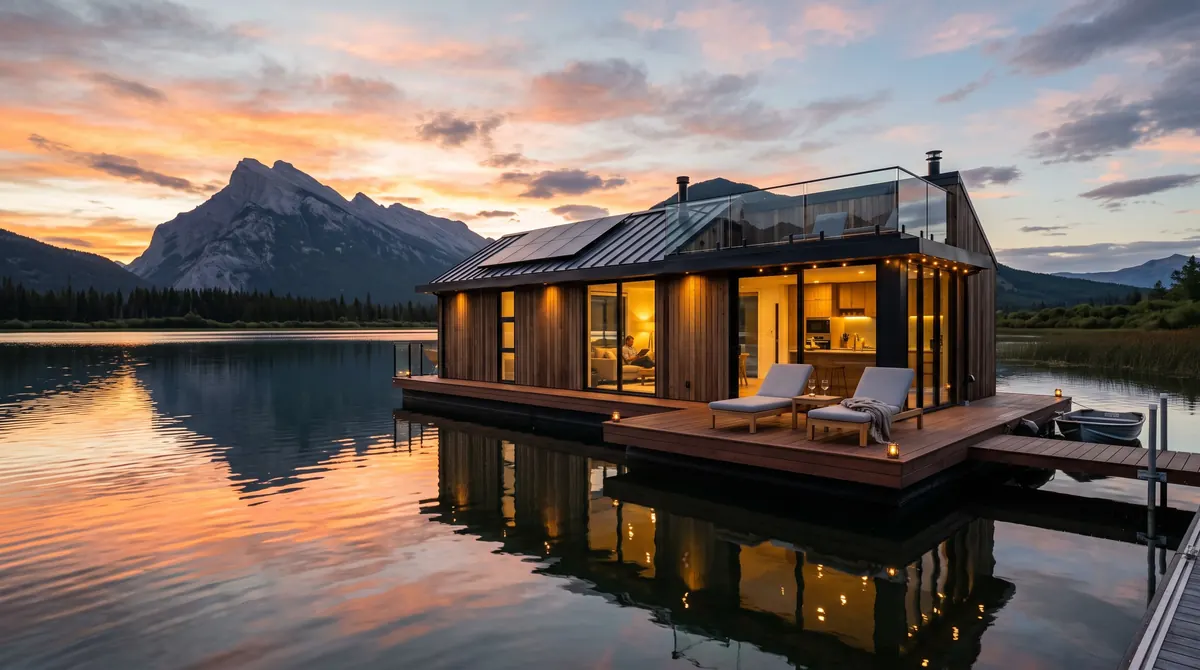
Location, permits, running costs and day-to-day operation decide whether a floating house works as a rental. A practical checklist before you invest.
Staying in a floating house is an experience many travellers remember: waking up above the water, coffee on the terrace, the sunset seen from the sofa. That uniqueness makes floating houses attractive for holiday rental. Still, like any investment, success depends on careful planning and realistic expectations.
This article covers the most important points to consider before you invest. It is not financial or tax advice — please discuss your specific plans with a qualified adviser.
1. Location decides almost everything
Guests book a place, not just a house. Ask yourself:
- Is the destination attractive in more than one season?
- Is it easy to reach by car, train or plane?
- Are there restaurants, activities and nature nearby?
- Is the mooring place quiet, safe and pleasant to look at?
A beautiful house in a location with a short season will usually earn less than a good house in a destination that attracts visitors all year round.
2. Make sure rental is allowed
Many municipalities regulate short-term rentals, and marinas often have their own rules. Before you buy, get written confirmation of:
- whether tourist rental is permitted at the mooring place,
- which registration or licence you need,
- which tourist taxes and reporting obligations apply,
- and whether there are limits on the number of guests or rental days.
Our article on permits and mooring explains the wider picture.
3. Calculate honestly
A simple model makes it easier to compare scenarios. Start with the potential revenue:
Revenue = average nightly rate × number of booked nights
Then subtract all running costs. This overview shows what to include:
| Cost item | What to check |
|---|---|
| Mooring fee | Annual berth rent or water-surface lease, and how it is indexed |
| Utilities | Electricity, water, waste water and internet |
| Insurance | Building, contents, liability and cover for rental use |
| Cleaning and laundry | Cost per changeover and linen service |
| Maintenance | Regular care of facade, terrace and technical systems |
| Booking commissions | Fees charged by booking platforms or agencies |
| Taxes and fees | Tourist tax, income tax and local charges |
| Management | Your own time, or a local service partner |
Be conservative with occupancy, especially in the first year, and model a quiet season as well as a strong one. The purchase price, transport, installation and preparation of the mooring belong in the investment calculation, together with any financing costs.
4. Choose the right model for your guests
The ideal size depends on who you want to welcome:
- Couples and short breaks: a compact house such as the FD-40 or the FD-60 is efficient to run and easier to keep booked.
- Families and small groups: two bedrooms, as in the FD-80, broaden your market.
- Premium stays: the FD-100 and FD-120 offer more space and a higher level of comfort, which can support a higher nightly rate.
Several smaller units can spread the risk better than one large house — but they also multiply the cleaning and management work.
5. Plan the day-to-day operation
A rental house is a small hospitality business. Think about:
- Check-in: a keyless entry system makes arrivals easy for guests and for you.
- Guest information: clear instructions for life on the water, the safety equipment and the house rules.
- A local service partner: someone nearby for cleaning, small repairs and emergencies.
- Durable interiors: robust materials and easy-care surfaces save money over the years.
6. Understand the risks
Some factors cannot be fully controlled: changes in local regulations, the weather, seasonality, new competition and the wider economy. Financing can also differ from classic real estate, as not every lender treats a floating house like a property on land. Talk to your bank early, and keep a financial reserve for quieter periods and unexpected repairs.
Conclusion
A floating house can be an attractive and distinctive rental property — when the location is right, the permits are clear and the numbers have been calculated with care. We do not promise returns. What we can do is help with the part we know best: choosing the right house and configuring it for rental use. Try the configurator or ask us for a proposal.
This article provides general information only and is not legal, tax or financial advice. Rules differ between countries, regions and waterways — always check with the competent local authorities and qualified advisers.
Back to the blog